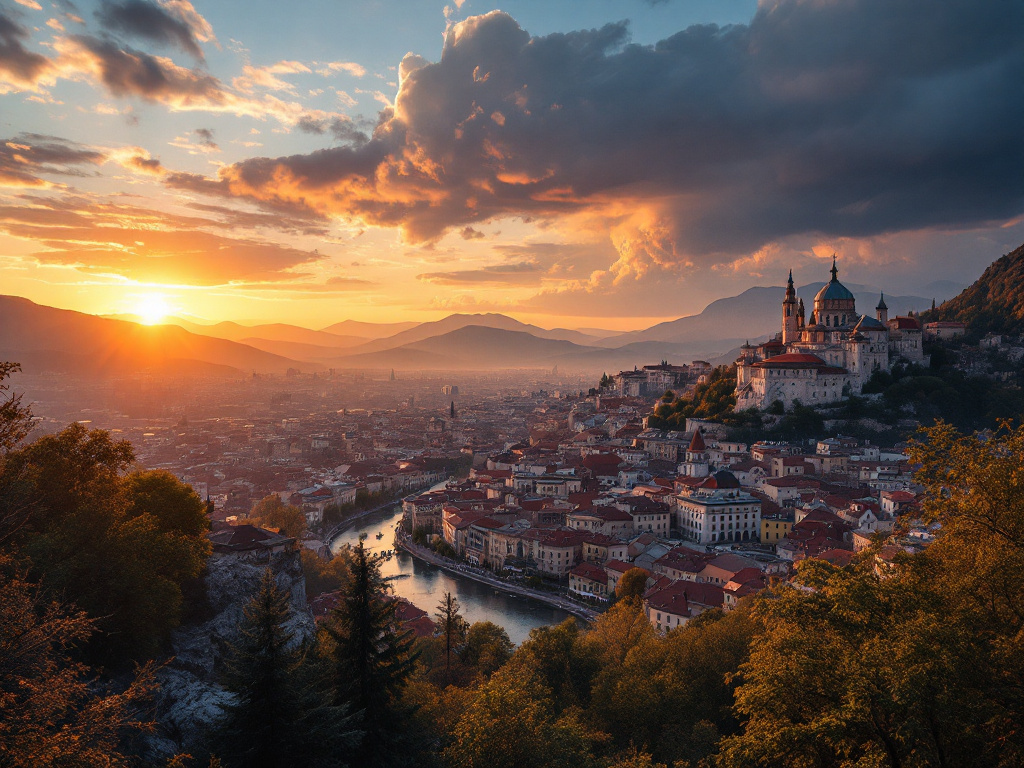
Sarajevo: Where Empires Left Their Kitchens
Four days in the city where Ottoman bazaar, Austro-Hungarian boulevard, and Yugoslav modernism share the same narrow valley — and the cevapi is better than anywhere else on earth.
Highlights
- Cevapi and kajmak at a Baščaršija hole-in-the-wall at noon
- Bosnian coffee ritual in a traditional kafana
- Trebević cable car and pine forest walk
- The Latin Bridge and the street that started World War I
- War Childhood Museum
- Žuta Tabija fortress at sunset over the valley
- Fresh burek from a 5am pita bakery
The Experience
Sarajevo sits in a narrow valley where the Miljacka River threads between hills steep enough that the city had no room to sprawl, only to layer. Ottoman quarter pressed against Austro-Hungarian boulevard pressed against Yugoslav modernism, each century's architecture stacked directly onto the last. You can walk from the Baščaršija — the old bazaar whose copper craftsmen have been hammering since the 15th century — to the Latin Bridge where a single pistol shot in 1914 ended one era of European history and began another, in about eight minutes. This compression is not symbolic. It is how the city actually works: the past is not a museum here, it is the street you are standing on.
The food is the most honest thing about Sarajevo. Cevapi arrive in a flatbread called a somun, with raw onion and kajmak — a clotted cream that splits the difference between crème fraîche and butter — and if you eat them at a correct Baščaršija spot you will understand why Sarajevans spend decades in diaspora dreaming about lunch. Burek comes from bakeries that open at five in the morning and are sold out of the best pieces by ten. The pita here — meat or spinach or cheese baked in coiled pastry — is Balkan, not Greek, and the distinction matters enormously to people who make it. Saturday morning means visiting the pijaca open market with the rest of the city. The produce is local because it has nowhere else to come from.
The coffee culture has Ottoman roots and its own vocabulary. A Bosnian coffee arrives in a džezva — a small brass pot — alongside a sugar cube, a lokum, and a small glass of water, and the ritual of pouring and waiting and drinking is not rushed, because rushing a Bosnian coffee is understood as the behavior of someone who has not yet learned to sit. The cafes of the Baščaršija and the hillside quarters above it operate on this schedule. The city's newer coffee shops, in the Skenderija area and south across the river, bring the same unhurried sensibility to third-wave equipment. You will have very good coffee and nowhere urgent to be, which is a fine way to spend a morning.
Then there is the weight. Sarajevo endured a siege from 1992 to 1996 that lasted longer than the siege of Leningrad, and the city carries that memory without drama or self-pity — in the roses painted red into the pavement where mortar shells landed, in the War Childhood Museum, in the way people talk about the nineties as a fact of life that happened and then life continued. This is not dark tourism. The city is alive and full of people who want good coffee and a seat in the sun. The history is not an attraction; it is a dimension that gives Sarajevo a moral seriousness that few cities possess, and that makes ordinary pleasures — a good meal, a walk uphill at dusk, the call to prayer echoing between minarets — feel freighted with something you cannot quite name.
Four days gives you enough time to get lost in the Baščaršija, climb to the old fortress at Žuta Tabija for the valley view, take the rebuilt cable car up Trebević for a walk in the pine forest, sit in a kafana long enough that the owner brings you something you didn't order, and eat cevapi more times than you planned. Sarajevo is not an easy sell: it is small, landlocked, complicated, and requires more of the traveler than a city built to be visited. That is precisely why the people who go there can't stop talking about it.
Want a personalized itinerary for this trip?
Sign up to get AI-generated day-by-day plans tailored to your preferences.
Plan Your Itinerary