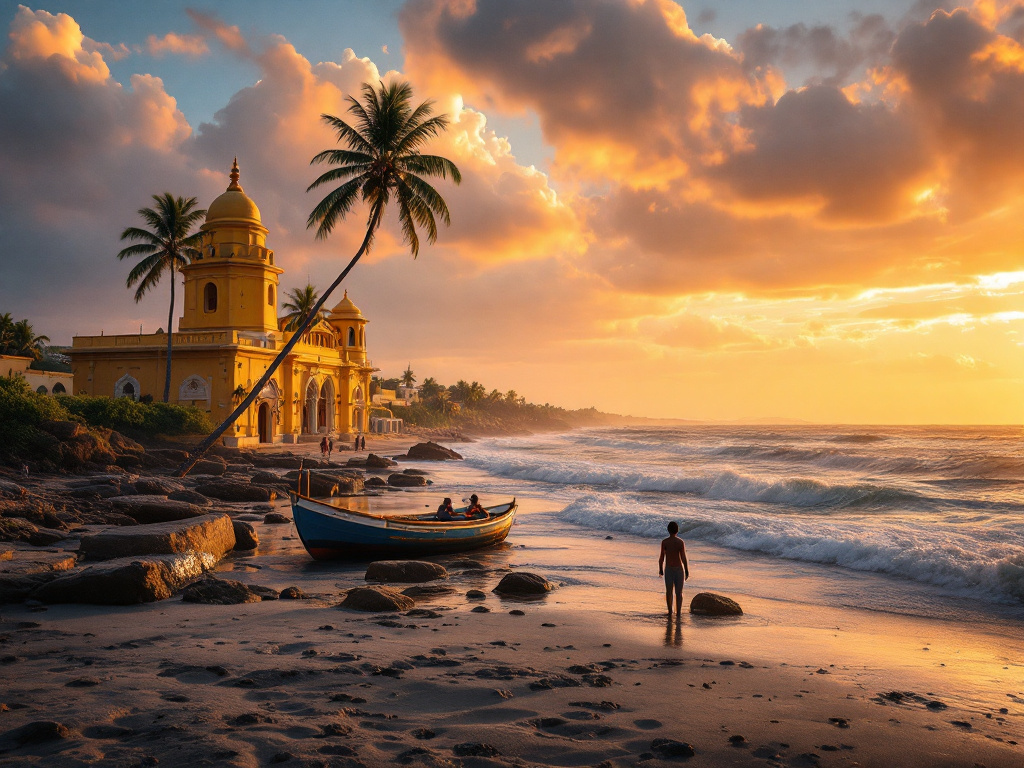
Yellow Walls & Temple Drums: A Long Weekend in Pondicherry
Former French colony, Tamil sacred city, and yoga retreat town — Pondicherry is three places at once, and the friction between them is exactly what makes it worth the journey.
Highlights
- Café au lait with south Indian filter biscuits in a White Town courtyard
- Sunrise walk on the promenade before the day heats up
- The Matrimandir at Auroville
- Sri Manakula Vinayagar temple's elephant blessing
- Croissants and cardamom buns from a colonial-era bakery
The Experience
Pondicherry arrives in two distinct worlds separated by a canal that cuts through town like a politely drawn boundary. On one side, White Town unfolds in grids of mustard and ochre colonial buildings, shuttered windows facing the Bay of Bengal, garden courtyards concealing cafés that serve café au lait with south Indian filter biscuits. On the other, the Tamil Quarter pulses with temple gopurams, flower-sellers stacking jasmine chains before dawn, and family-run tiffin spots turning out idli and sambar so practiced it seems effortless. The distance between the two is less than ten minutes on foot. The gap between worlds feels every bit that close and that far.
The French arrived in 1674 and stayed until 1962, and what they left isn't a tourist costume. It's baked into the infrastructure: the street grid, the buildings, the quiet Brahmin streets where French names still mark the corners. Locals speak Tamil first, French second, English third — a sequence that tells you everything about the town's hierarchy. The Alliance Française still runs a library. And yet every morning, a fisherman's shrine outside the basilica gets covered in marigolds, and the drums at Sri Manakula Vinayagar start before you have finished your first café crème.
Sri Aurobindo Ashram anchors the spiritual life of Pondicherry in a way that doesn't feel like performance. Founded in 1926 by the philosopher-revolutionary Sri Aurobindo and Mirra Alfassa (known here simply as The Mother), the ashram draws practitioners who come to stay for weeks, not hours. Auroville, the utopian township twelve kilometers north, was the experiment they envisioned: a community of nationalities living without money or religion. After fifty years it is a working city of 3,000 people and a place that confounds every expectation you bring to it. You don't need to be a seeker to visit either. The silence at the Matrimandir alone justifies the ride out.
What makes Pondicherry genuinely worth the journey, beyond the charm, is the food. The coastal setting means fresh seafood in both traditions: prawn moilee served on banana leaf from a family restaurant in the Tamil Quarter and bouillabaisse-adjacent fish stew at a white-tablecloth colonial house in White Town. The bakeries here are a particular revelation. French patisserie technique absorbed into local hands over decades produces croissants alongside cardamom buns, proper baguettes alongside banana-leaf-wrapped sweet pongal. Morning hours in Pondicherry are best spent hunting the finest breakfast across both sides of town, and no two days need to lead to the same answer.
The town draws a particular traveler: wellness-curious but not evangelical, interested in design and architecture, comfortable with an unscheduled afternoon. High season runs November through February, when the coast catches a cool breeze and the light turns golden by four in the afternoon. Even in the shoulder months, when the heat rises and the crowds thin, Pondicherry holds the stillness of a place that doesn't depend on outsiders for its sense of itself.
Want a personalized itinerary for this trip?
Sign up to get AI-generated day-by-day plans tailored to your preferences.
Plan Your Itinerary