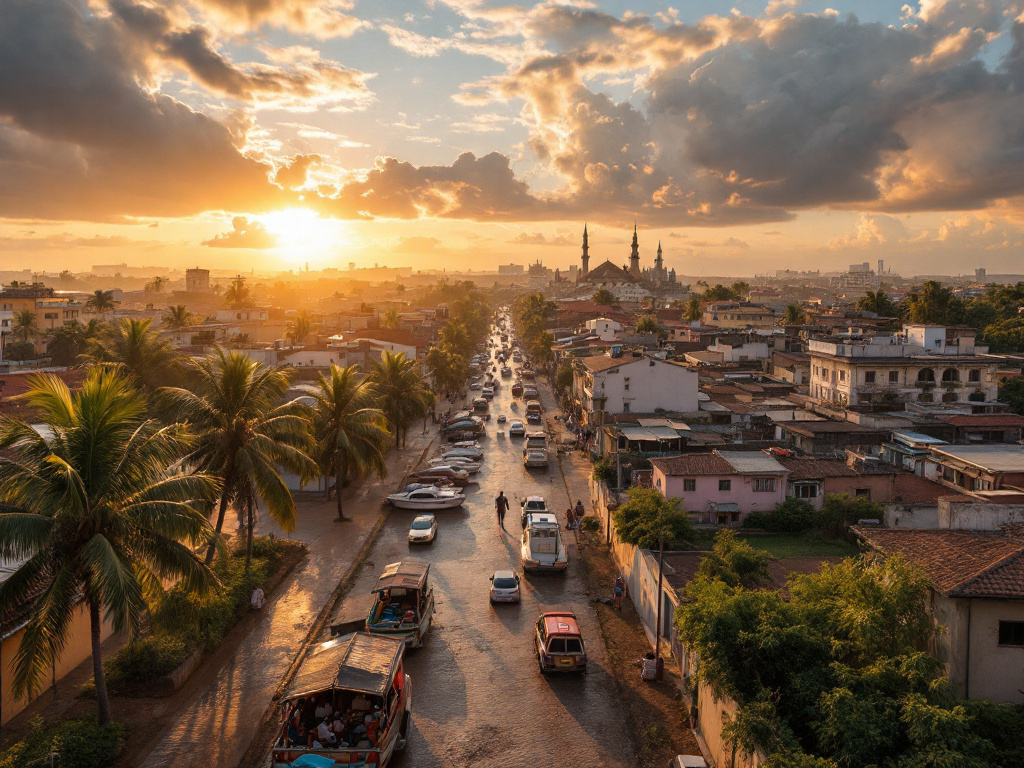
Accra Unbound: Jamestown, Afrobeats & Ghana's Return Generation
West Africa's most confident capital pairs a colonial fishing quarter turned open-air mural gallery with a live-music scene that never really stops, plus a sobering, essential day trip to the slave castles at Cape Coast.
Highlights
- Jamestown's colonial lighthouse and Ga fishing harbor at dawn
- Chale Wote street art murals through Jamestown and Ussher Fort
- Live highlife and Afrobeats at La Chapelle or +233
- Cape Coast and Elmina slave castle day trip
- Osu's Oxford Street design boutiques and Kwame Nkrumah Memorial Park
The Experience
Accra does not arrange itself for a tourist. The city sprawls along the Gulf of Guinea in loud, unbroken motion, tro-tros weaving past roadside grills, gutters running toward a surf that fishermen have worked for generations. Jamestown, the old town, is where that motion slows into something legible: a colonial lighthouse leaning over a harbor packed with hand-painted canoes, Ga fishing families mending nets on the same stone quays their grandparents used, boxing gyms training kids in open-air rings a block from the water. It is one of the poorest neighborhoods in the city and also, since the Chale Wote street art festival took root here a decade ago, one of the most visually alive, its crumbling colonial facades layered with murals that get reworked year over year rather than preserved behind glass.
The pull past the history is the present tense. Ghana's 2019 'Year of Return' campaign, inviting the African diaspora home five centuries after the transatlantic slave trade began, permanently rewired Accra's creative economy, and the energy never really left. Osu's Oxford Street runs indie fashion boutiques and concept stores next to suit tailors who've been on the block for thirty years. Highlife and Afrobeats acts play small rooms like +233 and La Chapelle most nights of the week, not just weekends, and the crowd is a real mix of Accra natives, returnees, and West African expats rather than a tour-bus audience. Food is argued over with total seriousness: kelewele sold from a single cart gets loyalty the way a Michelin star does elsewhere, and the correct way to make jollof rice is a border dispute Ghana has never conceded to Nigeria.
An hour and a half west, Cape Coast and Elmina hold two of the largest former slave-trading castles on the West African coast, whitewashed and stark against the Atlantic, their dungeons preserved exactly as brutal as they were. It is not a comfortable stop, and it should not be. Ghanaian guides, many of them descendants of the region, walk visitors through the Door of No Return with a directness that reframes everything seen in Accra's galleries and clubs the next day: this is a country whose creative confidence was built in spite of, and in direct response to, that history. Kwame Nkrumah's mausoleum back in the capital, honoring the man who led Ghana to become the first sub-Saharan African nation to win independence, closes the loop.
Accra suits travelers who want a real, working African capital rather than a curated version of one; it rewards people willing to walk, sweat, negotiate a taxi fare, and sit through a three-hour dinner that turns into a highlife set. It is not built around a single postcard moment. It is built around a rhythm, and four days is enough to find it.
Want a personalized itinerary for this trip?
Sign up to get AI-generated day-by-day plans tailored to your preferences.
Plan Your Itinerary