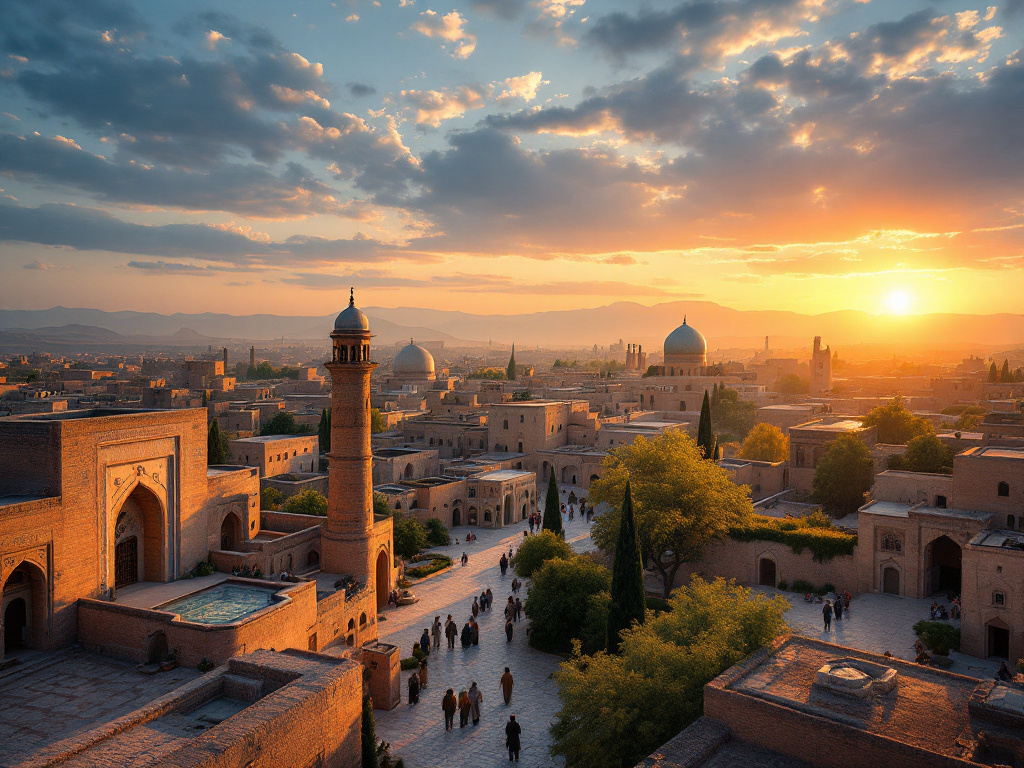
Bukhara: Silk Road Courtyards, Suzani Workshops & Uzbekistan's Slowest City
Skip Samarkand's postcard glamour for Bukhara, a still-lived-in Silk Road old town where embroidery workshops, mulberry-shaded teahouses and a 2,000-year-old Jewish quarter sit inside one walkable medina.
Highlights
- Suzani embroidery and miniature painting workshops in the Toki Zargaron trading dome
- Sunset tea and plov at the chaikhanas around Lyabi-Hauz pool
- Kalyan Minaret and the Poi Kalyan mosque-madrasa complex
- Bukhara's 2,000-year-old Jewish quarter, synagogues and cemetery
- The Ark fortress, occupied for over a thousand years
- Boutique guesthouses inside restored 19th-century merchant courtyards
The Experience
Everyone tells you to go to Samarkand first. Its turquoise domes are real and worth the trip, but Samarkand's old core was largely rebuilt for the postcard, and it shows: wide plazas, tour buses idling at golden hour, a city center that empties out after the last group photo. Bukhara is the other kind of Silk Road city, the one where roughly 140 protected monuments sit inside a old town that people still actually live in. Families hang laundry over 15th-century archways. Kids play football in the square outside the Kalyan Minaret, the tower so imposing Genghis Khan reportedly spared it when he burned the rest of the city in 1220. Nothing here was rebuilt for you. It just never stopped being used.
The craft economy is the reason to slow down. Bukhara's trading domes, Toki Zargaron and Toki Sarrafon, once housed jewelers and money-changers under Silk Road-era brick cupolas; today they hold small workshops where you can watch suzani embroidery being stitched by hand, miniature painters working with squirrel-hair brushes and lapis pigment, and block-printers stamping walnut-oil ink patterns onto cotton and silk the same way their families have for generations. None of this is staged for tour groups, it is genuinely how a meaningful share of the old city still earns a living, and the workshops are happy to talk technique if you show real interest rather than just shopping.
Evenings belong to Lyabi-Hauz, a 400-year-old stone pool ringed by mulberry trees planted when the pool was built, now surrounded by open-air chaikhanas serving green tea in handleless piala cups and plates of plov cooked in enormous cast-iron kazans. Old men play chess at low tables until well after dark, and the call to prayer from the surrounding madrasas overlaps with the clatter of tea being poured. It is unhurried in a way that is hard to fake, the kind of public square that a city builds for itself rather than for visitors, and it happens to be one of the most photogenic places in Central Asia at dusk.
Bukhara's other undersold layer is its Jewish quarter, one of the oldest continuously inhabited Jewish communities in the world, dating to at least the 2nd century BCE. The neighborhood's synagogues, courtyard houses and cemetery are still active and visitable, and a handful of families remain who can walk you through a history that predates the Silk Road trade routes that made the city famous. Combined with the Ark fortress, a citadel occupied for over a thousand years until 1920, and the Chor Minor with its four mismatched turquoise towers, Bukhara rewards travelers who want architecture with a lived context rather than a roped-off exhibit.
A new generation of boutique guesthouses has opened inside restored merchant courtyard homes over the last few years, most run by Bukharan families who converted their own historic properties, and a small wine and craft-coffee scene has followed. This suits travelers who want texture and craft over nightlife, who would rather learn to read a suzani pattern than take a party bus, and who are willing to spend three unhurried days in a city that has no interest in rushing them.
Want a personalized itinerary for this trip?
Sign up to get AI-generated day-by-day plans tailored to your preferences.
Plan Your Itinerary