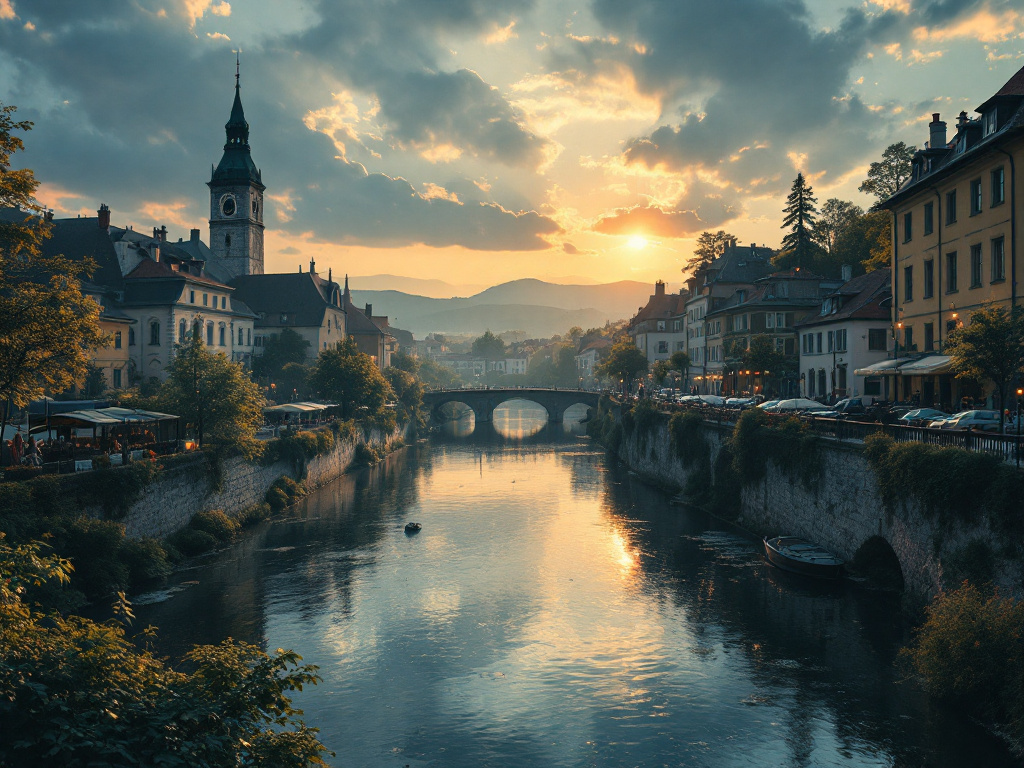
Ljubljana Underground: Cafés, Craft Beer & the Alternative Capital
Slovenia's tiny green capital, where a squatted military barracks became an art commune, Plečnik's riverside architecture frames a market of local growers, and everyone seems to know the name of their regular café.
Highlights
- Metelkova City alternative culture complex
- Plečnik's Central Market colonnade
- Dragon Bridge and the Ljubljanica riverside cafés
- Ljubljana Castle funicular and hilltop views
- Tivoli Park
The Experience
Ljubljana doesn't announce itself. It has no Charles Bridge crowds, no Eiffel Tower silhouette, nothing that trends on its own. What it has instead is a river lined with plane trees and café terraces, a car-free old town small enough to memorize in an afternoon, and a permanent, low-key hum of people actually living their lives in public. Locals linger over macchiatos at outdoor tables for hours, students spill out of the university library onto the Ljubljanica's banks, and nobody seems to be rushing anywhere. It is the kind of place that makes you recalibrate what a capital city is supposed to feel like.
The heart of the city's alternative identity is Metelkova, a former Austro-Hungarian and later Yugoslav army barracks that a coalition of artists and squatters occupied in the early 1990s rather than let it be demolished. Three decades on it's a permanent, self-governed complex of galleries, DIY music clubs, queer and feminist collectives, and some of the most unhinged outdoor sculpture and mural work in Europe, still repainted and reworked by the people who use the space. It runs almost entirely on its own terms, no corporate sponsors, no curated Instagram aesthetic, just a functioning autonomous zone that happens to also be a great night out.
By day, the center of gravity shifts to the Ljubljana Central Market, architect Jože Plečnik's riverside colonnade where farmers from the surrounding hills sell cheese, honey, and produce alongside a covered fish market and a rotating cast of small food stalls. Plečnik shaped most of what makes the old town visually distinctive, the Triple Bridge, the arcaded market halls, the pyramid-topped National and University Library, and walking his additions is a quieter, more personal way to see a city's architecture than any museum. Craft beer has also quietly taken over here; a wave of small breweries and taprooms has opened in the last decade, run by people who left corporate jobs to make sour ales and imperial stouts a few streets from where their grandparents drank Union pivo.
This suits travelers who want the charm of Prague or Vienna without the tour groups, people who'd rather find their own café than be handed a laminated map of ten must-see spots. It's compact enough to cover on foot or by bike in three days, calm enough to actually slow down in, and still has a genuine underground running beneath its postcard surface. The dragon statues on the bridge into the old town are the closest thing to a mascot, fitting for a city that quietly, stubbornly, does its own thing.
Want a personalized itinerary for this trip?
Sign up to get AI-generated day-by-day plans tailored to your preferences.
Plan Your Itinerary