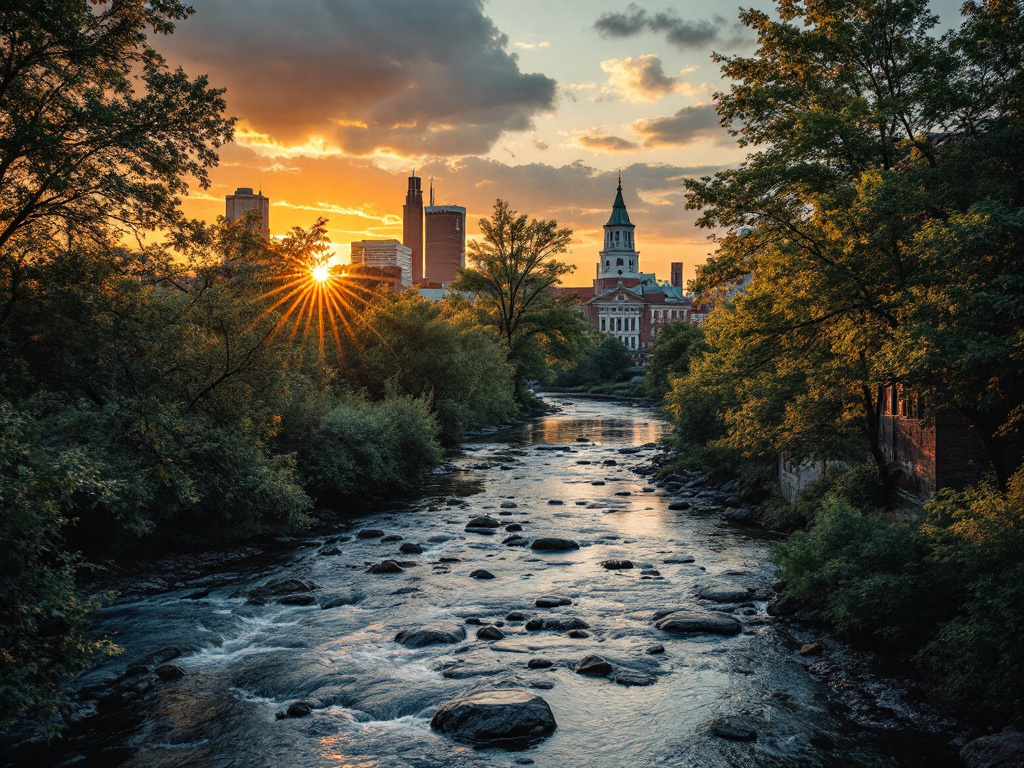
Richmond Remade: Rapids, Rowhouses & the New Southern Table
Class-IV rapids running through downtown, a former industrial corridor turned brewery district, and a Southern food scene that stopped apologizing for itself.
Highlights
- Class III-IV whitewater rapids running through downtown on the James River
- Scott's Addition, a former industrial corridor turned dense brewery district
- Church Hill's rowhouses and skyline views from St. John's Church
- Richmond's outdoor mural collection, a legacy of the RVA Street Art Festival
- Belle Isle's granite outcroppings for swimming and sunset
The Experience
Richmond has spent the last decade quietly becoming one of the most interesting cities on the East Coast, and it still hasn't quite gotten the memo to start acting like it. This is a city that runs whitewater rapids through its own downtown, where you can put in a kayak a few blocks from the state capitol and be swept past skyscrapers on Class III and IV water within minutes. That kind of geographic accident sets the tone for the whole place: unpretentious, a little wild at the edges, and never trying too hard to sell itself.
The James River Park System threads the city together, thirty-some miles of trails and rock outcroppings that locals use the way other cities use a subway. Belle Isle, once a Civil War prison camp and a hydroelectric plant before that, is now where half the city goes to swim, sunbathe on granite slabs, and watch the sun drop behind the Lee Bridge. Richmond's relationship with its own history is layered and unresolved in exactly the way that makes a place worth paying attention to. It was the capital of the Confederacy; it's also home to some of the most extensive public conversation about Reconstruction and racial history anywhere in the South, from the Richmond Slave Trail to the reworked monuments along Monument Avenue.
Scott's Addition, a grid of low brick warehouses that used to make everything from Model Ts to cigarettes, has become one of the densest brewery districts in the country almost by accident, one garage-door taproom at a time. A few miles east, Church Hill climbs a ridge of nineteenth-century rowhouses to St. John's Church, where Patrick Henry gave the speech, and the view from the top over the river and the skyline is one of the best in the mid-Atlantic and one of the least photographed. In between, VCU's enormous arts program keeps pumping a steady supply of painters, muralists, and chefs into the city, and it shows: Richmond has one of the country's best outdoor mural collections, a legacy of the old RVA Street Art Festival that never really stopped.
The food follows the same pattern of quiet confidence. This is a city where a chef can plate rabbit crepinette next to a country ham biscuit without irony, where the Southern canon gets reworked rather than reenacted. Carytown's mile of independent shops and diners, the Fan's leafy blocks of Victorian houses turned into wine bars and record shops, and Jackson Ward's jazz-age history as "the Harlem of the South" all give the food scene somewhere specific to come from.
Richmond suits travelers who want a city that still feels like it belongs to the people living in it: walkable, affordable by East Coast standards, layered with unresolved history, and built around a river you can actually get into. It's a weekend for people who'd rather find their own mural than follow someone else's map to it.
Want a personalized itinerary for this trip?
Sign up to get AI-generated day-by-day plans tailored to your preferences.
Plan Your Itinerary