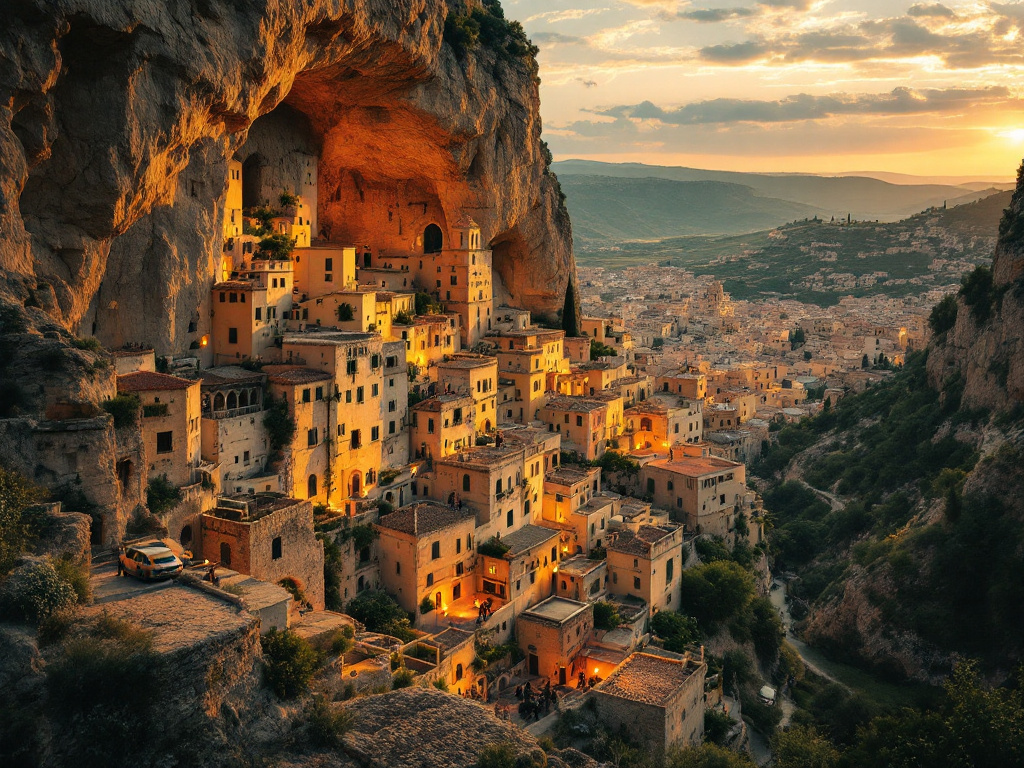
Sassi After Dark: Matera's Cave City & Basilicata Wine Country
A slow three days inside Europe's oldest continuously inhabited city: cave-carved streets, Aglianico wine from the Vulture volcano, and a canyon hike to rock churches that predate the Sassi themselves.
Highlights
- Sunset over the Sassi cave dwellings from the Belvedere near Murgia Timone
- Dinner in a cave restaurant carved into the tufo rock
- Hike across the Gravina canyon to the rock churches of Murgia Materana Park
- Pane di Matera IGP from a wood-fired bakery
- Aglianico del Vulture tasting in a former grain-storage cave
- MUSMA contemporary sculpture museum inside a 16th-century cave palazzo
The Experience
Matera doesn't look like it should still be standing, let alone lived in. The Sassi, two ravine-side districts of houses, churches and stables carved directly into soft tufo limestone, were inhabited more or less continuously since the Paleolithic, which makes this one of the oldest surviving settlements on earth. By the 1950s the Italian state had decided the Sassi were a national disgrace, families raising children and livestock in one-room caves with no plumbing, and forcibly relocated everyone to new housing on the plateau above. The caves sat empty and half-collapsed for decades. Then, slowly, they didn't. Architects, hoteliers and a wave of people who wanted something Rome and Florence had stopped being able to offer moved back in, and Matera became a UNESCO site and, eventually, a European Capital of Culture. What you get now is a city that still remembers being poor, wearing its rehabilitation without polishing off the strangeness.
The eating and drinking here runs on Basilicata, one of Italy's least-visited and most under-rated regions. Pane di Matera, a dense durum-wheat bread baked in wood-fired ovens and stamped with its own protected designation, shows up at every table, still made the way bakers here have made it for generations, and it is worth building a meal around on its own. Peperoni cruschi, sun-dried sweet peppers fried to a shattering crisp, and caciocavallo hung to age in cave cellars because the temperature never moves, are the local staples worth ordering without translation help. And the wine is Aglianico del Vulture, grown on the slopes of an extinct volcano an hour north, dense and dark and almost nothing like the Chianti and Barolo everyone already knows. A handful of enotecas built into old grain-storage caves pour it by the glass to a mostly Italian crowd who came for the wine, not the view, even though the view is right there.
At night the Sassi go quiet in a way that most Italian old towns don't anymore. There's no strip of identical aperitivo bars competing for tourists. Instead there's a scatter of small, deliberately unmarked wine bars tucked into former cave dwellings, a jazz club that programs like it means it, and MUSMA, a contemporary sculpture museum installed inside the caves and cellars of a sixteenth-century palazzo, open late on summer evenings when the stone rooms hold the day's heat. Walk up to Piazzetta Pascoli or the Belvedere near Murgia Timone after dinner and the whole cave city lights up gold across the ravine, church by church, with none of the crowd you'd fight for the same view in Cinque Terre.
The daytime move is to leave the Sassi entirely and cross the Gravina, the deep limestone canyon the city was built to overlook. A footbridge and a network of goat paths drop you into Murgia Materana Park, where hermit monks carved chiese rupestri, rock churches, into the canyon walls starting in the eighth century, frescoes still faintly visible on stone that predates the cathedral back in town. The hike back up delivers the postcard shot of the Sassi from across the ravine, cave windows stacked on top of each other like something drawn rather than built, and it costs nothing but a couple of hours and decent shoes.
Matera suits travelers who've done their Rome and Florence and want an Italy that feels unfinished and a little eerie rather than fully restored, who'd rather sit with a glass of Aglianico than fight for a table on the Ponte Vecchio. It's small enough to walk in a day and strange enough to want three, and it rewards exactly the kind of unhurried wandering that a checklist itinerary would ruin.
Want a personalized itinerary for this trip?
Sign up to get AI-generated day-by-day plans tailored to your preferences.
Plan Your Itinerary