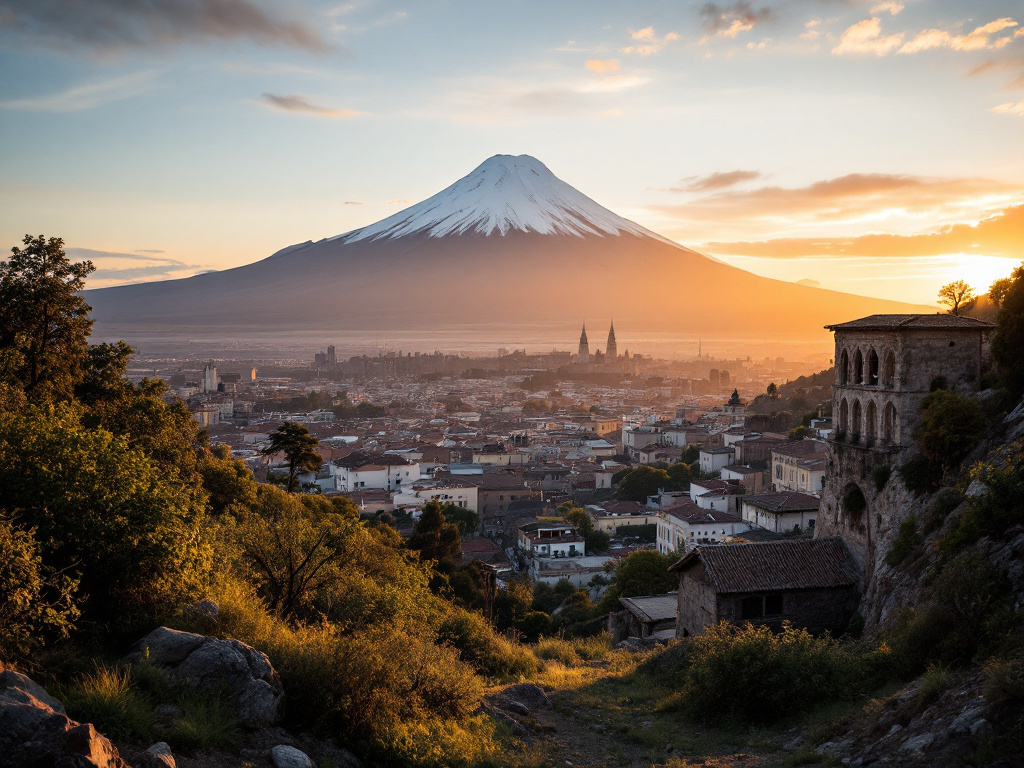
White Stone, Dark Coffee: Arequipa and the Peru Most Travelers Miss
Three days in Peru's volcanic White City — sillar-stone cloisters, ancient picanterías serving rocoto relleno, a craft coffee scene that finally caught up with the altitude, and El Misti watching everything from above.
Highlights
- Sillar-stone cloisters of Santa Catalina Monastery
- Rocoto relleno at a traditional picantería lunch
- Single-origin pour-over at a Plaza de Armas café
- El Misti silhouette at sunset from Yanahuara mirador
- Chupe de camarones at Mercado San Camilo
The Experience
Arequipa doesn't announce itself. You step off the bus or the plane and the air is thinner than you expected — the city sits at 2,335 meters, high enough that your first espresso hits differently — and then you look up and El Misti is just there, a near-perfect volcanic cone watching the city from the north. Most travelers pass through Arequipa on the way to Cusco, or stop for a night before heading to Colca Canyon. That's a mistake worth correcting with a longer look.
The White City earns its name. The entire centro histórico is built from sillar, a pale volcanic stone quarried from the same lava fields that made El Misti, and on a clear afternoon the streets glow almost impossibly bright. The Monastery of Santa Catalina is the city's showpiece — a walled city within the city, where 200 nuns lived in near-total seclusion for four centuries, and where the ochre- and terracotta-painted lanes still feel like a Castilian village dropped into the Andes. You can spend three hours inside and still not see all of it.
The food culture is the real secret. Arequipa is one of three or four places in Peru that can credibly argue it feeds people better than Lima — and the locals will make that argument without much prompting. The picanterías are ancient tavern-restaurants that have served the same dishes since the colonial era: ocopa (yellow potato in a walnut-and-chili sauce), chupe de camarones (a thick shrimp chowder that tastes like someone slow-cooked the Andes), and rocoto relleno, a small volcanic pepper stuffed with ground meat and baked until the heat becomes something you want more of. Lunch at the Mercado San Camilo is an education.
Coffee followed the food eventually. The city's café scene took its time, but there are now serious specialty roasters working with single-origin beans from Cajamarca and San Martín, and the streets around the Plaza de Armas have become one of those rare spaces where you can sit with a pour-over and not feel like you're being herded toward a souvenir stall. Wander up to the Yanahuara district for the best mirador in the city — a row of sillar arches framing El Misti and the valley below, which at sunset looks like something invented to make people reconsider their flight out.
Arequipa moves at the speed of altitude. The pace is deliberate, lunches are long, evenings are cool enough for a jacket even in summer. It doesn't try to be Cusco, and that restraint is exactly what makes it worth three days of your attention.
Want a personalized itinerary for this trip?
Sign up to get AI-generated day-by-day plans tailored to your preferences.
Plan Your Itinerary